
Sylnovia © 2026 · All Rights Reserved
The single most expensive way to test a product concept is writing full production backend and frontend code. If you spend three months building a complex feature only to discover upon launch that customers find the workflow confusing, you have burned months of engineering runway. The fundamental objective of prototyping is to validate assumptions using the absolute minimum time and capital required.
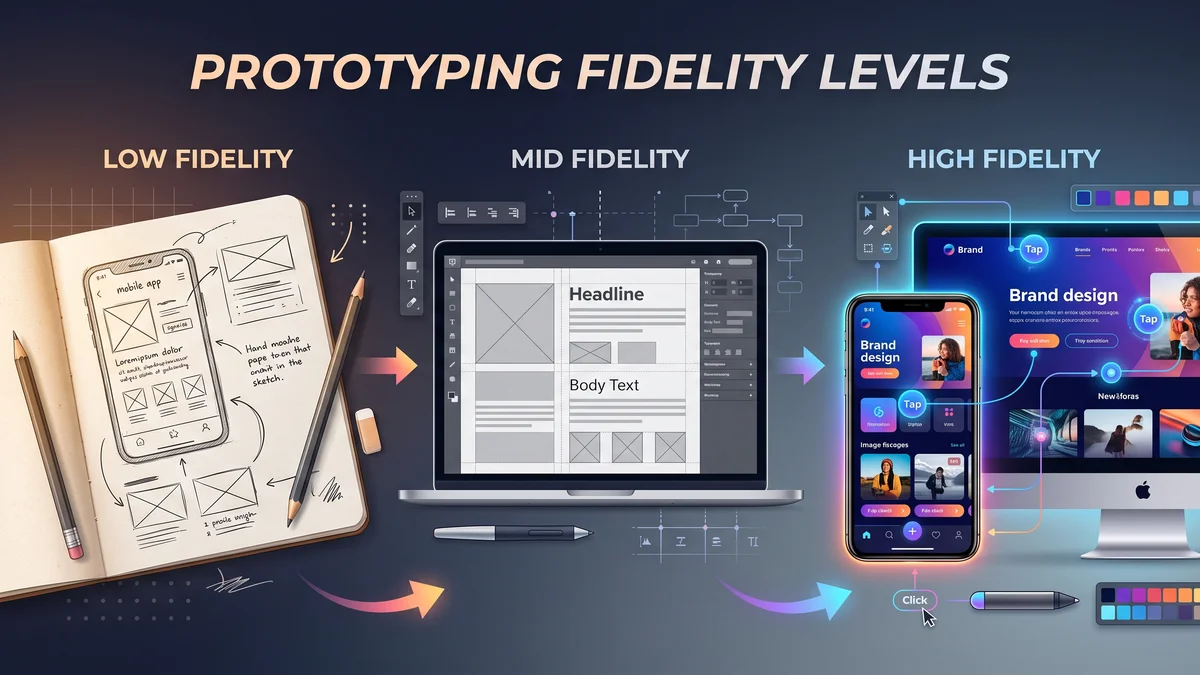
High-velocity product teams match their prototyping fidelity directly to the specific questions they need to answer.
Best for early exploratory brainstorming sessions. Quick hand-drawn wireframes allow product managers and developers to explore multiple structural layouts and conceptual models in hours rather than weeks. Total cost: zero.
Structural layouts rendered in grayscale without brand colors or photography. Best for testing information architecture, navigation hierarchies, and screen flows. By deliberately omitting colors and fonts, stakeholders focus on workflow logic rather than debating color shades.
Pixel-perfect interactive prototypes featuring real branding, typography, micro-interactions, and clickable user flows. Essential for conducting unmoderated usability testing with real target customers, securing investor funding, and aligning cross-functional teams before sprint planning.
When an application relies heavily on dynamic calculations, keyboard navigation, or complex interactive canvas manipulations that cannot be accurately simulated in design tools, spinning up a lightweight code prototype with mock JSON data provides definitive validation.
Never treat prototypes as precious works of art. A prototype is a disposable learning vehicle designed to test hypotheses. If user testing reveals that a flow is fundamentally flawed, celebrate the discovery—you just saved your company months of wasted engineering effort.
At Sylnovia, we guide startups and enterprises through rapid, low-risk prototyping cycles that validate business ideas before writing code. Partner with our product design team for your next innovation sprint.
Delivering deep technical insights, architectural blueprints, and digital strategy for modern engineering squads.

The Strategic Hiring Dilemma for Growing Businesses When leadership teams decide to build a custom software platform or...
The False Dichotomy of Manual vs. Automated QA In software engineering discussions, testing is often framed as an all-o...
Why Enterprise B2B Buyers Mandate SOC 2 Type II When selling software to Fortune 500 enterprises, healthcare organizati...